

Sub-Total: $0.00
G10 vs. Rubber: The Ergonomics and Material Science of Handgun Grips
When most owners look at upgrading their handgun, they focus on sights or triggers. However, the grip interface is the only point of constant mechanical contact between the operator and the platform. Choosing between materials like G10 and rubber isn’t just an aesthetic choice – it’s a decision rooted in ergonomics, friction coefficients, and geometry.
- The Geometry of the Grip: Trigger Reach and Bore Axis
The thickness of your grip panels directly alters the mechanical leverage you have over the trigger. This is often measured as “trigger reach” – the distance from the backstrap to the face of the trigger.- High-Profile Grips: Thicker rubber or palm-swell grips increase the circumference of the frame. This can be beneficial for operators with larger hands to prevent “finger wrap,” where the trigger finger reaches too far through the trigger guard.
- Slim-Profile Grips: G10 materials can be machined much thinner than rubber while maintaining structural integrity. Thinner grips allow the hand to wrap further around the frame, effectively lowering the hand’s position relative to the bore axis and reducing felt muzzle flip.
- Material Science: G10 vs. Rubber
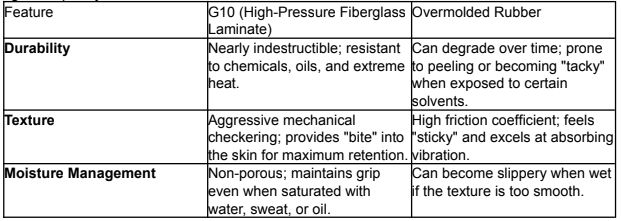
Understanding how these materials behave under environmental stress is key to choosing the right setup for your environment.
- Mechanical Feedback and Recoil Management
Rubber grips are often preferred by high-volume shooters for their ability to dampen vibration. The material compresses slightly under recoil, acting as a secondary shock absorber. However, this compression can lead to a “mushy” feel during high-speed manipulations. G10 provides zero compression. This offers the operator precise mechanical feedback and a more rigid index point. While it doesn’t absorb vibration, the aggressive texture ensures the platform does not shift in the hand during rapid cyclic rates.
- The Bench Summary
Selecting the right grip material is a balance of hand size, environmental conditions, and intended use. A precision-machined G10 grip offers longevity and a slim profile, while rubber offers comfort and vibration reduction. Before committing to a change, verify that your grip choice doesn’t interfere with the magazine release or the draw stroke of your specific holster configuration. If you’re evaluating the ergonomics of your current setup, checking for proper trigger finger
index and thumb-to-selector reach is the best place to start. A minor change in grip thickness
can lead to a major improvement in recoil control and accuracy.